Visiting Great Zimbabwe: A Guide to the Stone City
Photograph: Mike from Vancouver · CC BY 2.0. Source · All image credits

Home / Destinations / Great Zimbabwe
Last reviewed 18 Nov 2026. Draft for editorial review.
Great Zimbabwe is not a footnote to Victoria Falls. It is the monument from which the modern country takes its name, and one of the principal reasons to travel on after the Zambezi gorges — or to build a trip around the highveld and the south rather than around the Falls alone.
The account below follows the UNESCO World Heritage entry and the National Museums and Monuments of Zimbabwe (NMMZ) description. Opening hours, ticket prices, and on-site facilities are not listed here because they were not captured from a live official tariff in this draft. [NEEDS SOURCE: current NMMZ hours, fees, guide services, and photography rules before a “practical visit” box is added.]
Where it is, and what the name means
UNESCO places Great Zimbabwe National Monument approximately 30 km from Masvingo, in the lowveld, at an altitude of some 1,100 m. The brief UNESCO description says the historic city covers nearly 80 hectares. The inscribed property is larger: the Outstanding Universal Value text says it extends over almost 800 hectares, and the UNESCO listing gives the property area as 722 hectares. Those two scales are not a contradiction to blur together — the city and the wider protected property are different figures. Use them as UNESCO uses them.
UNESCO also notes that the Shona word Zimbabwe means “the house in stone.”
A long-standing legend, which UNESCO records, associates the ruins with the Queen of Sheba. That is a legend. The same official texts describe the site as a unique testimony to the Bantu civilisation of the Shona between the 11th and 15th centuries — and that historical identification is the one this guide follows.
A city of stone, in three parts
UNESCO states that the property, built between 1100 and 1450 AD, is divided into three groups: the Hill Ruins, the Great Enclosure, and the Valley Ruins.
The Hill Ruins stand on a granite mass. UNESCO says they were inhabited continuously from the 11th to the 15th centuries, with many layers of settlement. Enclosures of rough granite rubble are reached by narrow, partly covered passageways. The acropolis is generally considered a “royal city”: the west enclosure is thought to have been the residence of successive chiefs, and the east enclosure, where six steatite (soapstone) posts topped with birds were found, is considered to have served a ritual purpose.
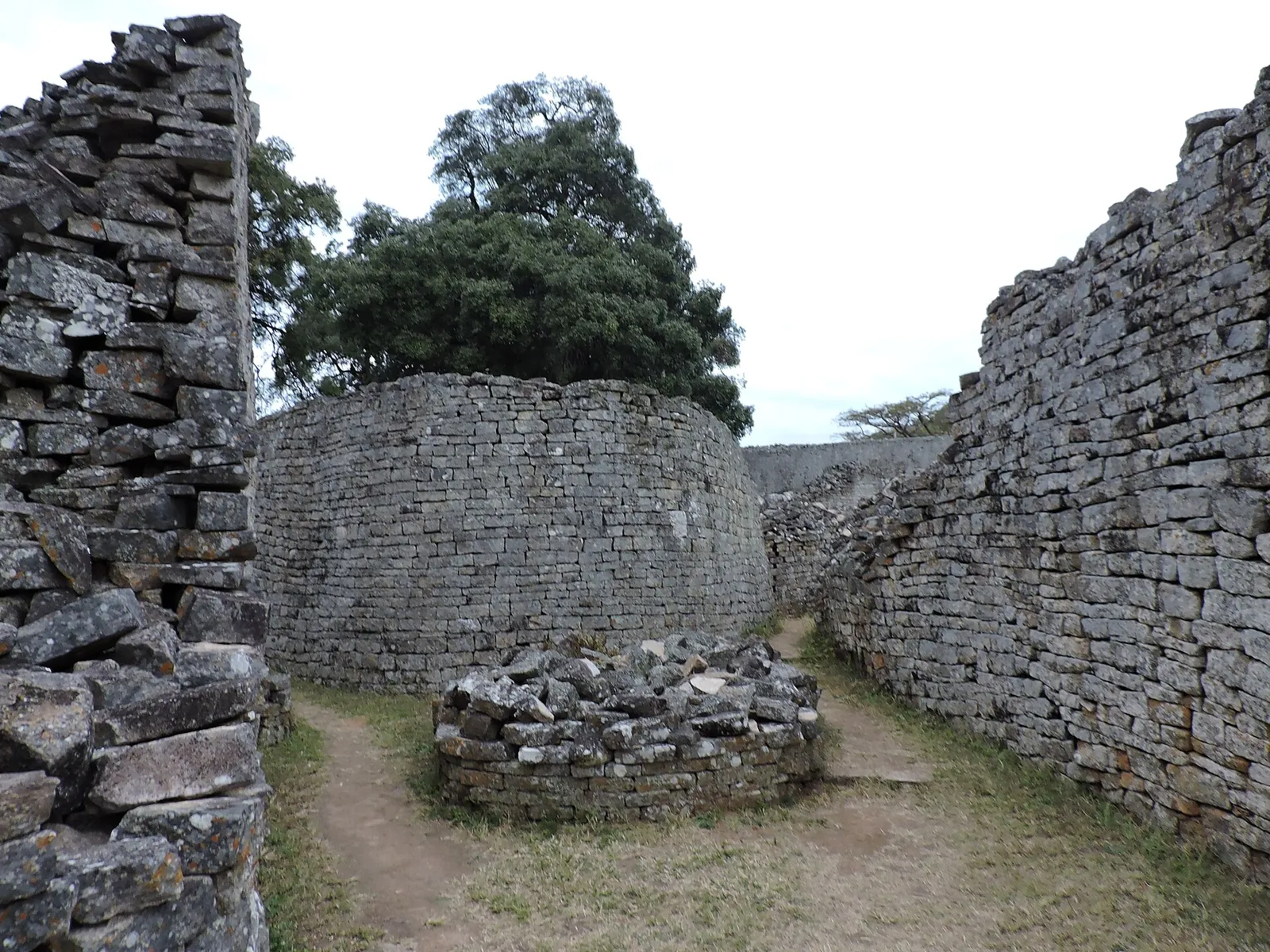
The Great Enclosure, south of the hills and dated by UNESCO to the 14th century, is elliptical. It was built of cut granite blocks in regular courses and contains daga-hut living quarters, a community area, and a narrow passage leading to a high conical tower. UNESCO describes daga as a mixture of granitic sand and clay. Internal walls marked off family areas, generally a kitchen, two living huts, and a court.
The Valley Ruins, in UNESCO’s account, are living ensembles scattered through the valley and dated to the 19th century, with brick constructions and dry-stone walls, including chevron and chequered decoration.
NMMZ adds that Great Zimbabwe is the largest and most impressive of more than 300 Zimbabwe-type dry-stone walled structures scattered across Zimbabwe and southern Africa, and that the monument was inscribed on the World Heritage List in 1986 under criteria (i), (iii) and (iv). (UNESCO’s OUV text on the same page discusses criteria (i), (iii) and (vi); if a later revision needs to unpack inscription criteria, quote both institutions carefully rather than merging them.)
What the city was
Scientific research summarised by UNESCO says Great Zimbabwe was founded in the 11th century, on a site that had been sparsely inhabited in the prehistoric period, by a Bantu population of the Iron Age, the Shona. In the 14th century it was the principal city of a major state on the gold-rich plateaux; UNESCO states that its population exceeded 10,000 inhabitants.
About 1450, UNESCO writes, the capital was abandoned because the hinterland could no longer furnish food for the overpopulated city and because of deforestation. Political weight later shifted, including towards Khami.
Excavations have revealed glass beads and porcelain from China and Persia, and gold and Arab coins from Kilwa — evidence, in UNESCO’s words, of long-standing trade with the wider world, alongside potsherds and ironware that point to farming and pastoral life.
The soapstone Zimbabwe Birds found at the site are described by UNESCO as figurines with which the entire nation has identified; the bird has been adopted as a national emblem, and “may have been a royal totem.” The site remains, in UNESCO’s authenticity statement, a sacred archaeological place that contemporary communities still use for spiritual reasons. Visitors should treat it as such: stay on permitted paths, follow staff and guide instructions, and do not assume that every enclosure is a backdrop for photographs.
How a visit sits in a wider trip
Great Zimbabwe is not on the Victoria Falls–Hwange road. Masvingo is a different axis of the country, which is exactly why the site belongs on a “beyond the Falls” itinerary rather than as an afterthought to a weekend at the gorges.
A common planning pattern is Harare–Masvingo (and onward, for some travellers, towards the Eastern Highlands or back to the capital). [NEEDS SOURCE: current official road distances, coach or air options, and typical driving times — do not invent hours or kilometre counts beyond UNESCO’s “approximately 30 km from Masvingo.”]
If your trip begins or ends in Harare, a night in the city on either side of the Masvingo road is a practical buffer.
The Hilltop Guesthouse offers 13 rooms and suites in Emerald Hill, approximately 5 km from Harare’s Central Business District, with rooms starting from US$120 per night and continental breakfast included (official Hilltop website, checked 18 November 2026). Confirm current rates, check-in time, and availability on the official site before you book. [NEEDS SOURCE: agree Greg’s ownership-disclosure sentence before publication.]
Safari days at Hwange or Mana Pools are a separate leg of the country; they are covered on this site in their own guides rather than compressed into this monument article.
What this draft deliberately omits
- Ticket prices, hours, and whether a licensed guide is required on the day you go — [NEEDS SOURCE from NMMZ].
- Nearby lodge names and room rates — [NEEDS SOURCE from each property; do not invent a “where to stay in Masvingo” list].
- Claims about “best light” or crowd levels — [NEEDS SOURCE].
- Any retelling of the Queen of Sheba story as history.
Image suggestions (none used yet)
Rights-cleared images only. Record licence, author, and source URL. Preferred: original photographs of the Great Enclosure, the conical tower, and the Hill Ruins, taken with whatever photography rules NMMZ sets on the day.
Alternatives to verify on the file page before download:
- Wikimedia Commons search:
Great Zimbabwe,Great Enclosure,Zimbabwe Bird(for the emblem, prefer museum or official images with a clear licence; do not imply a photograph is in situ if it is not). - UNESCO media on the World Heritage page may be available under specified terms — read the licence on each file. UNESCO’s text itself is offered under CC-BY-SA IGO 3.0; that licence covers the description, not automatically every photograph in the media player.
- Do not publish ritual activity or identifiable worshippers without permission.
Suggested placements: Great Enclosure or enclosure wall below the introduction; Hill Ruins later in the “three parts” section; a clearly captioned map only if you have a rights-cleared or original graphic.
Sources
- UNESCO World Heritage Centre, “Great Zimbabwe National Monument,” https://whc.unesco.org/en/list/364/ (fetched 18 November 2026). Description available under CC-BY-SA IGO 3.0.
- National Museums and Monuments of Zimbabwe, “World Heritage Sites,” https://www.nmmz.co.zw/world-heritage-sites/ (fetched 18 November 2026).
- The Hilltop Guesthouse, https://thehilltopguesthouse.co.zw/ and https://thehilltopguesthouse.co.zw/rates/ (13 rooms; Emerald Hill, about 5 km from the CBD; rooms from US$120; continental breakfast included). Checked 18 November 2026.