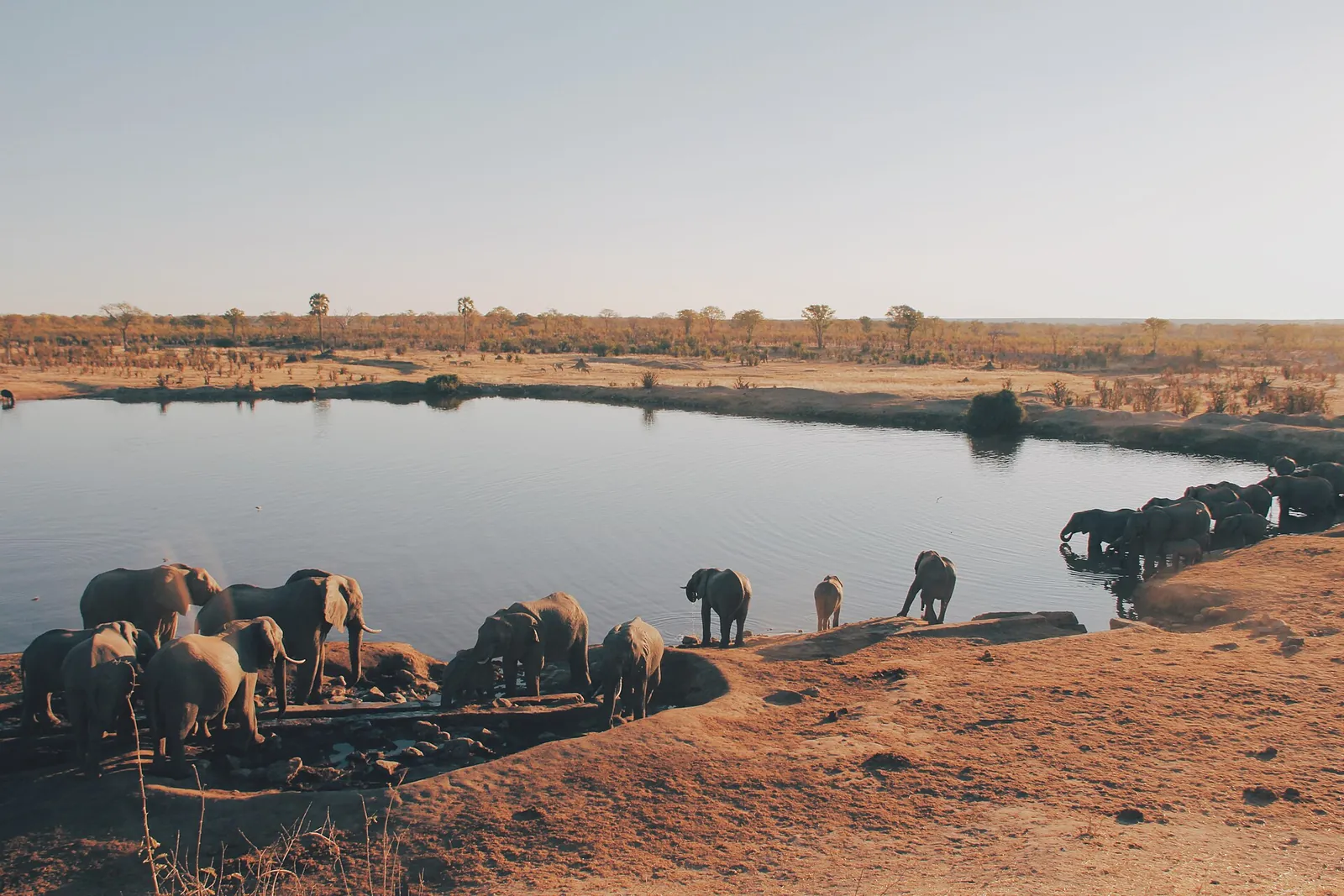
Hwange National Park: A First-Timer's Guide Beyond Victoria Falls
Photograph: Christine Donaldson · CC0 1.0. Source · All image credits

Home / Destinations / Hwange National Park
Last reviewed 18 Nov 2026. Draft for editorial review.
Victoria Falls is often the first Zimbabwe stamp in a passport. Hwange is one of the most straightforward places to go next: Zimbabwe’s largest national park, in the northwest of the country, on the road and air corridor that already serves the Falls.
This guide stays with facts that can be checked on official pages. Park conditions, camp availability, and road quality change; confirm details with Zimbabwe Parks and Wildlife Management Authority (ZimParks) before you travel.
Zimbabwe’s largest national park
ZimParks describes Hwange National Park as the country’s largest, in northwestern Zimbabwe, covering 14,650 square kilometres. The Authority’s Hwange General Management Plan uses a legal area of 14,651 km² and notes that GIS mapping indicates a slightly larger figure of 14,710 km². The same plan states that the park was established as a conservation area in 1928 and formally proclaimed a national park in 1959, in North-West Matabeleland.
The official park page characterises the landscape as mostly savanna grasslands with teak and mopane woodlands.
A 2026 ZimParks investment prospectus places the park in the Kavango Zambezi Transfrontier Conservation Area (KAZA) and repeats the 1,465,100-hectare (14,651 km²) figure.
Wildlife — what official sources actually say
On its Hwange page, ZimParks writes that the park holds the largest elephant population in Zimbabwe and “Africa’s largest population of the endangered wild dog,” and that visitors may find uncommon species such as roan and sable. It lists 100 mammal species and nearly 400 bird species.
The same page is careful about the “big five.” The heading uses the phrase “Home of the big five,” but the body lists “four of the big 5: elephant, lion, leopard and buffalo.” This draft therefore does not claim that rhinoceros are a reliable viewing highlight. [NEEDS SOURCE: current, official status of rhino in Hwange, if Greg wants that question answered in a later revision.]
The 2026 prospectus estimates Hwange’s elephant population at 45,000. Treat that as a published estimate, not a census you can repeat forever; populations and survey methods change.
The three camps, in outline
The General Management Plan splits the park into three management units, each with its own headquarters and tourism activity:
- Main Camp — 10,765 km²
- Sinamatella — 1,328 km²
- Robins — 2,679 km²
The plan also notes that a station is being developed at Makona in the south and may in time become a fourth unit. For a first visit, the practical point is simple: Hwange is not a single gate with a single circuit. Where you stay changes which part of this very large park you will actually see.
[NEEDS SOURCE: current public camp, lodge, and hide options, fees, and booking channels — quote only from a live ZimParks or concession page when this article is updated for publication.]
How official directions describe access
ZimParks publishes road and air notes on the park page. The figures below are that page’s figures, not independently measured distances.
Main Camp by road
- From Bulawayo: travel 283 kilometres towards Victoria Falls, turn left at Cross Mabale on the Bulawayo / Victoria Falls highway, then 23 kilometres on tar to the park.
- From Victoria Falls: travel 172 kilometres towards Bulawayo, turn right at Cross Mabale, then 23 kilometres on tar.
Robins Camp by road
- From Bulawayo: the official page describes travelling 283 kilometres towards Victoria Falls, turning left at Cross Mabale, and continuing 145 kilometres through the park, past Main Camp, towards Robins.
- From Victoria Falls: travel 46 km along the Victoria Falls–Hwange highway, turn right at the Pandamatenga turn-off, and continue 64 km towards Robins Camp.
By air
ZimParks states that an airstrip exists at Main Camp for private or charter aircraft, with prior permission to land required from Main Camp; that a serviced airstrip exists at Robins Camp; and that visitors can fly into Victoria Falls International Airport and then travel by road (the page gives 100 kilometres “to the respective camp” — confirm which camp you mean, because the two road descriptions above are not the same length).
[NEEDS SOURCE: scheduled airline or shuttle options in the current season; do not invent transfer times or fares.]
Health and conduct in the park
The official park page flags malaria and asks visitors to take the necessary precautions. It also cautions about elephants with calves. Take both seriously, and follow current medical advice from your own clinician or a travel clinic — this article is not medical advice.
ZimParks suggests binoculars, cameras, walking shoes, reference material, enough food for the stay, a first-aid kit, and, for campers, a tent, sleeping bag, and torch. If you are booked into a serviced camp or lodge, check with your host what is already provided rather than assuming you must be fully self-sufficient.
When to go
This draft does not invent a “best month” chart. The official Hwange page, as fetched on 18 November 2026, did not publish a clear seasonal calendar for this park (a “what to wear” note on that page refers to Chimanimani National Park, which is a different destination, and is not used here).
[NEEDS SOURCE: a dated official or meteorological seasonal note for Hwange — rainfall, access, and wildlife concentrations — before any “best time to visit” subsection is published.]
UNESCO’s description of nearby Mana Pools, by contrast, does discuss dry-winter congregations of animals on the Zambezi floodplains. That is a Mana Pools fact, not a Hwange fact, and belongs in a Mana Pools guide.
If your itinerary also passes through Harare
Many Hwange trips never touch the capital: Victoria Falls is the usual international gateway in the official access notes above. If, however, you are arriving or leaving through Harare — for example because you are combining Hwange with Great Zimbabwe or a meeting in the city — you may want a quiet night in the capital before or after the long transfer.
The Hilltop Guesthouse is a 13-room guesthouse in Emerald Hill, about 5 km from Harare’s CBD, with rooms starting from US$120 per night and continental breakfast included (facts from the official Hilltop website, checked 18 November 2026). Check current rates and availability on that site. [NEEDS SOURCE: agree Greg’s ownership-disclosure sentence before this paragraph is published.]
For a fuller picture of staying in the capital, see the companion site’s stay guide once it is live on insidezimbabwe.com. Safari planning for Hwange itself stays here.
Before you publish a packing or booking list
Do not copy third-party “typical daily rates” or unnamed lodge reviews into this article. When this piece is updated for publication, add only:
- a link to the live ZimParks Hwange page and any official booking portal;
- named camps or concessions whose own sites you have checked;
- a date stamp at the top.
Image suggestions (none used yet)
Use only rights-cleared assets; record licence, author, and source URL before download. Preferred: Greg’s own photographs of Hwange (waterholes, mopane or teak woodland, clearly identified camps). Alternatives to confirm on the file page before any use:
- Wikimedia Commons search:
Hwange National Park— open candidate file pages and keep only those with a clear Creative Commons or public-domain licence, and captions that name the location accurately. - Do not use tour-operator or lodge photos without written permission.
- Avoid close images of people or staff unless you have consent.
Suggested placements, once licences are confirmed: a landscape or waterhole image below the introduction; a simple map or road-access graphic (original or officially licensed) near the access section; a woodland or elephant image only if the file is rights-cleared and not mislabelled.
Sources
- Zimbabwe Parks and Wildlife Management Authority, “Hwange National Park,” https://www.zimparks.org.zw/hwange-national-park/ (fetched 18 November 2026).
- ZimParks, Hwange General Management Plan (PDF), https://www.zimparks.org.zw/media/2024/07/Hwange-GMP.pdf (area, proclamation dates, management units).
- ZimParks, Investment Prospectus (PDF), https://www.zimparks.org.zw/media/2026/04/ZIMPARKS-INVESTMENT-PROSPECTUS.pdf (KAZA context; elephant population estimate of 45,000).
- The Hilltop Guesthouse, https://thehilltopguesthouse.co.zw/ (13 rooms; Emerald Hill; approximately 5 km from the CBD; rooms from US$120; continental breakfast included). Checked 18 November 2026.